


Riddle: What do the architects Óscar Niemeyer, Renzo Piano, Frank O. Gehry and Álvaro Siza have in common? All of them built some of their most emblematic architectural works in cities of Green Spain. When we say ‘works’ we mean buildings that can be visited, walked through, stepped on, photographed and lived in through cultural and artistic experiences of the highest order.
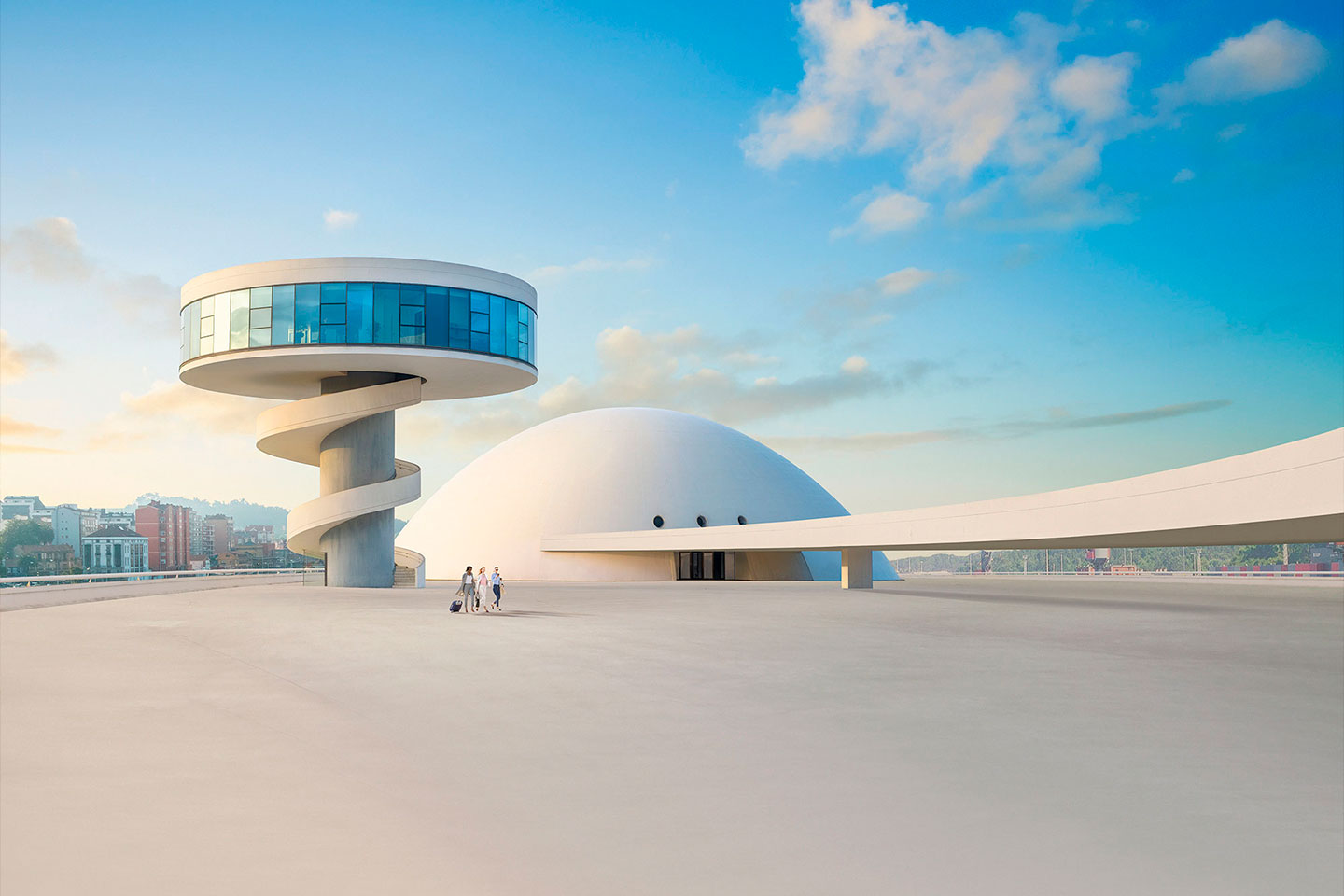
Niemeyer Center in Avilés. Asturias
What do I need to know about the Niemeyer Center in Avilés?
It is the only work of the Brazilian architect Oscar Niemeyer (one of the creators of the impressive city of Brasilia) in Spain and the most important that he ever made in Europe, according to his own words. The Niemeyer Center is also one of the last works of this architect, who died at the age of 104, just 18 months after the inauguration of the cultural complex in Avilés.
As in Bilbao or Santander, this center is the bold response of the city of Avilés to a question: What do we do with these lands dedicated for decades to heavy industry and located just a breath away from the old Avilés?
What should I not miss at the Niemeyer Center in Avilés?
Its human-scale proportions and the recognizability of its architectural proposal (with that iconic tower, the impressive auditorium or the dome emerging over the square…) make it easy to explore even for those who have no prior references. It is also essential to know the schedule of activities beforehand, as the Niemeyer Center is a living space with several exhibitions taking place simultaneously and an intense (and very changeable) programme of workshops, theatre or cinema.
A comfortable way to discover it and soak up Niemeyer’s thinking? Through the guided tours that show the centre.
Where can I get the best photograph for social media at the Niemeyer Center in Avilés?
- More than a ‘where’ we are going to recommend a ‘when’: when night falls, the lights come on and you can play with the shadows they cast over Niemeyer’s ghostly buildings.
- More than a photograph we are going to recommend a video: that of the cinematic ‘travelling’ obtained on board the narrow-gauge suburban train heading towards Llaranes and showing the Niemeyer Center ‘moving’ as if it were a spaceship.
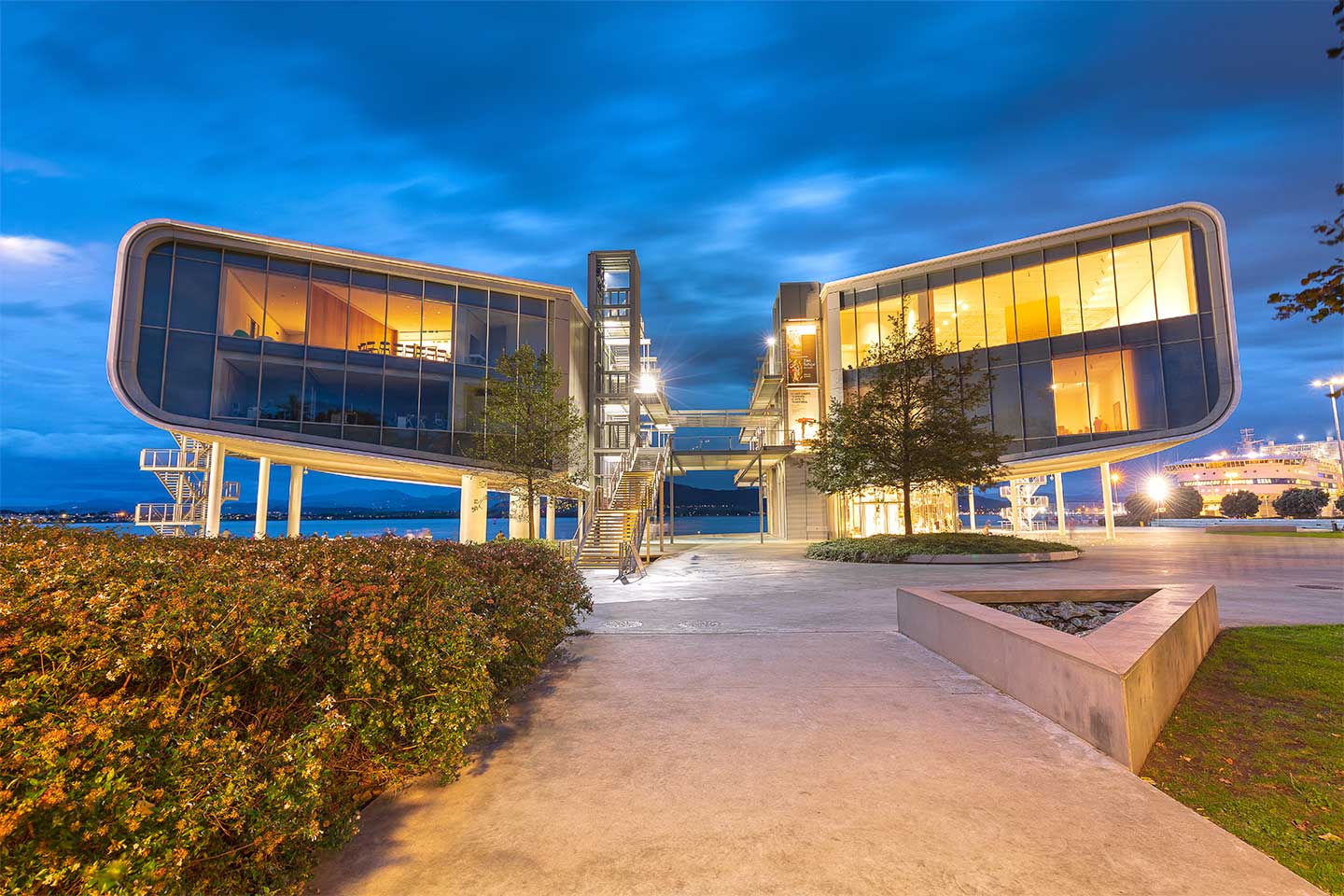
Botín Center in Santander. Cantabria
What do I need to know about the Botín Center in Santander?
That in this place where peace and art reign, just a few metres from the heart of Santander, there was once intense port and urban activity: a very busy roadway passed through here, now buried, and for 200 years there were docks that were fundamental to the economic development of the city. All this changed in 2017 with the inauguration of the Botín Center and the new approach to the area. Not only did cars disappear but the centenary Jardines de Pereda grew.
The creator of the Botín Center was architect Renzo Piano, Pritzker Prize winner in 1998 and author of the Georges Pompidou Centre in Paris. Piano accepted the challenge of building a space that would enhance creativity and cultural development in Cantabria, and dressed it with thousands of pearly ceramic pieces that reflect the tones of the Cantabrian Sea.
What should I not miss at the Botín Center in Santander?
The first thing to know is that the Botín Center experience transcends the interior spaces and that its terraces and walkways form an essential part of the visit. The panoramic views they offer of Santander Bay or the city itself are also art.
The interior of the Botín Center is a living space dedicated to contemporary art in which several exhibitions coexist at the same time. One of its strong points is its programme of activities, closely linked to temporary exhibitions (there is no permanently exhibited collection) and the artists: it will not be easy to forget the beautiful experience commissioned by Japanese artist Shimabuku in collaboration with the people of Santander. The same happened with those of Maruja Mallo, Roni Horn, the sculptures of Joan Miró or Picasso Ibero. So, who knows what unforgettable artistic experience is yet to come?
The content of the Botín Center can also be experienced in the auditorium through concerts, cinema and conferences so it is always advisable to check the agenda in advance.
Where can I get the best photograph for social media at the Botín Center in Santander?
- For a panoramic view of the building, from the Jardines de Pereda, with Renzo Piano’s building appearing among the trees and, in the distance, the bay. This view is ideal at sunset, as is the one obtained from the Palacete del Embarcadero.
- How about a water travelling shot? The ferry that links Santander with Pedreña and Somo will gift you a perfect view of the bay and of Piano’s building emerging before the Santander skyline. If you do it in the early hours of the day you will have the sun in your favour.
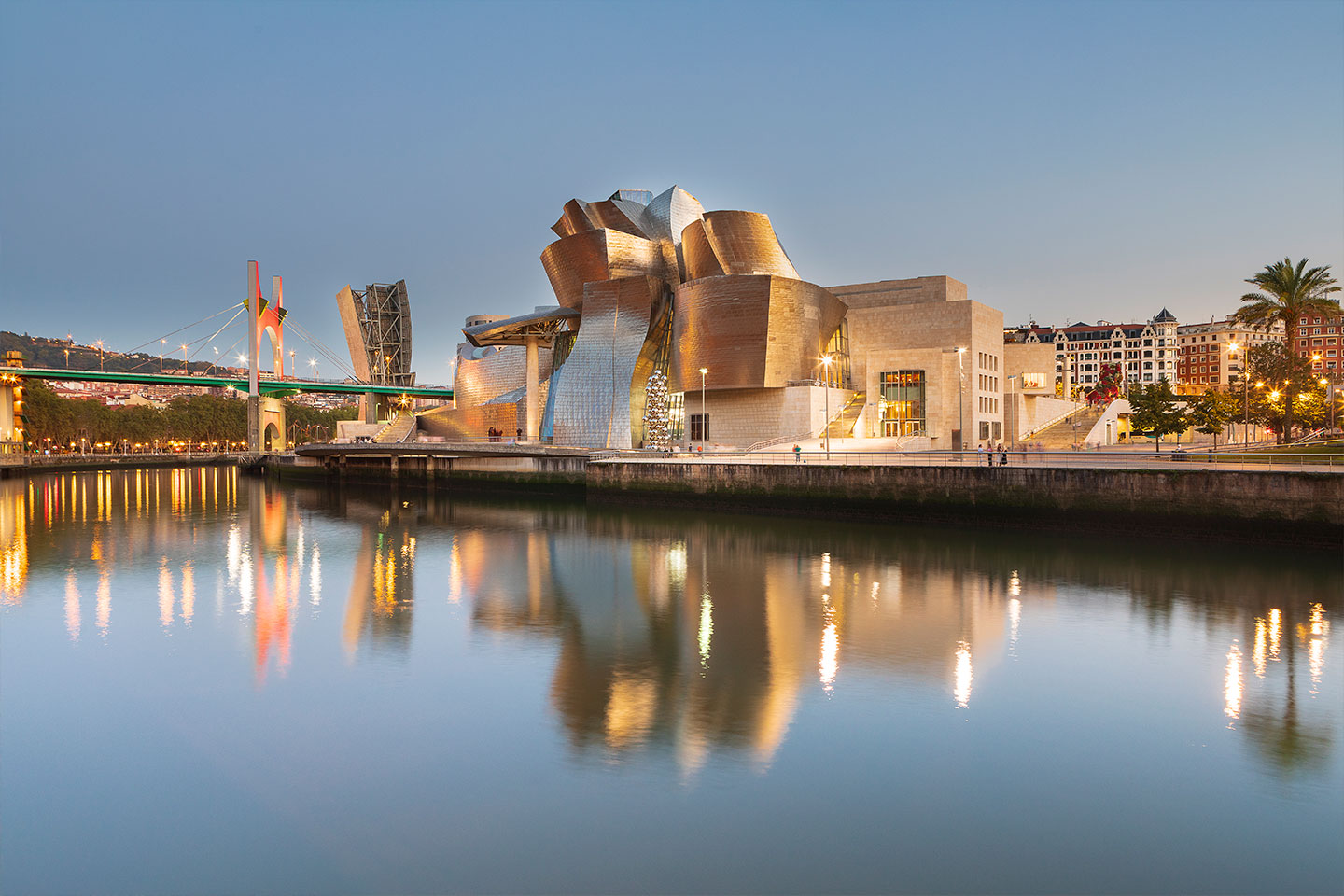
Guggenheim Museum Bilbao, Bizkaia. Baskeland
What do I need to know about the Guggenheim Museum Bilbao?
Something that more or less many people already know even if only by hearsay: that the creation of the Guggenheim Bilbao not only meant the recovery of a vast industrial space, but it is the clearest symbol of the rebirth of Bilbao. Designed by Canadian architect Frank O. Gehry and located on land that for decades had industrial use, the Guggenheim Bilbao is a slender titanium-clad building that, depending on where you look at it from, resembles a sail hit by the wind, a ship or a flower unfolding its petals.
What should I not miss at the Guggenheim Museum Bilbao?
The Guggenheim Bilbao is an architectural work that should not only be observed but, very importantly, should be walked through. Both outside and inside. And it is precisely outside where it must also be explored in depth, seeking its most iconic sculptures (‘Puppy’ the flowery dog by Jeff Koons or ‘Mamá’, the giant spider by Louise Bourgeois) or scanning the diverse surroundings, from the shaded areas under the La Salve bridge to the green areas in the western sector.
And the interior? There awaits another world of sensations, both in emblematic spaces (such as the main atrium or terraces) and in the most iconic works. The best examples may well be the colossal ‘The Matter of Time’ by Serra (where it is even possible to get lost), Holzer’s installation in which words ‘rain down’, the granite and alabaster sculptures of Chillida or the iconic yellow and red canvas by Rothko.
Where can I get the best photograph for social media of the Guggenheim Bilbao?
- Anyone wishing to enjoy it from above only has to ascend the La Salve bridge to fly over the museum. If those views do not satisfy them, they can take the funicular of Artxanda to reach the viewpoint of this emblematic Bilbao hill and, from there, obtain a panorama not only of the museum but of the whole capital of Bizkaia.
- Seeing (and photographing or filming) the Guggenheim Museum through the tram windows is quite a delight for the eyes, as well as a first-rate tourist experience.
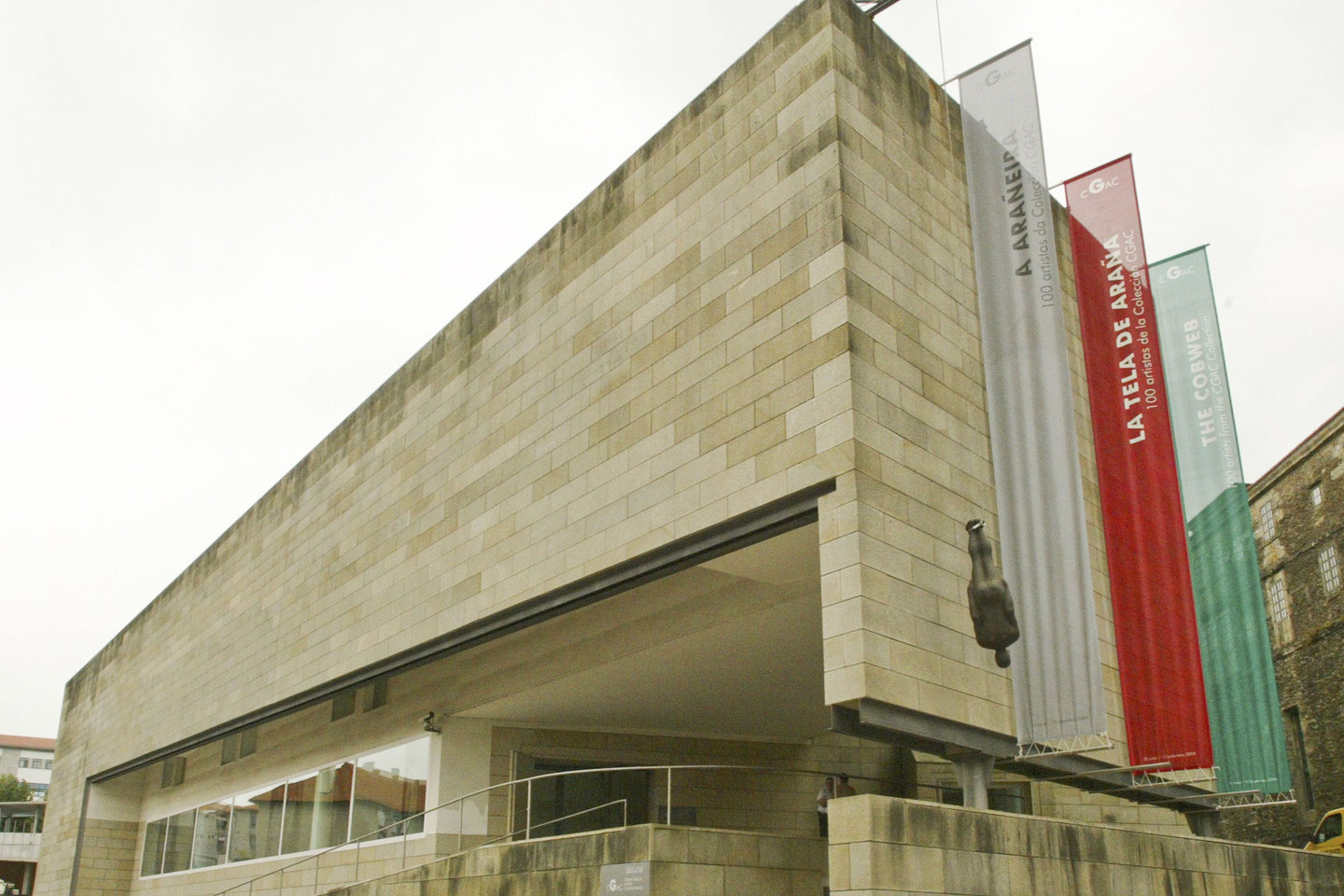
Galician Center of Contemporary Art in Santiago de Compostela, A Coruña. Galicia.
What do I need to know about the Galician Center of Contemporary Art (CGAC)?
It is the most veteran of all the contemporary art spaces we talk about in this post and one of the pioneers in Spain in highlighting a forgotten quadrant of a major capital. And not only that. Much of the architectural greatness of the Galician Center of Contemporary Art lies in its ability to contrast with its surroundings. Did you know that just a few metres from this avant-garde twentieth century building stands the Gothic church of the convent of San Domingos de Bonaval, built in the thirteenth century? Or that in the immediate vicinity there is a peaceful park (Bonaval Park)?
Portuguese architect Álvaro Siza took all this into account when designing this building that blends with its surroundings and at the same time modernises them.
What should I not miss at the Galician Center of Contemporary Art?
The artworks it exhibits by Galician, national and international artists and the way it displays them: the space created by Siza is a welcoming geometric environment with a minimalist aesthetic. Depending on the time of day of the visit, the effect of the light through the windows completely transforms the spaces and the works exhibited in them.
The game proposed by Álvaro Siza continues beyond the museum’s borders and extends throughout the neighbouring Bonaval Park in which the architect, in collaboration with Isabel Aguirre, integrated several dispersed elements (the aforementioned convent, a medicinal garden, ruins, sculptures, a beautiful oak grove and the Bonaval cemetery) to create a unique space.
One last secret: it would be a shame to arrive at the CGAC and stroll through Santiago in search of the best avant-garde architecture and not discover the astonishing helical staircase (that is, spiral) located in the neighbouring convent of San Domingos de Bonaval. It is baroque but it amazes even the most modern visitor!
Where can I get the best photograph for social media at the CGAC?
- At the point where the Rua de Bonaval begins you get a surprising picture: the façade of the CGAC posing alongside the baroque entrance of the Bonaval monastery. Five centuries of architectural history almost embraced.
- From the roof of the CGAC itself it is possible to obtain a very revealing panorama of the old town of Santiago de Compostela and, of course, of the rear of the façade of the Cathedral with the two bell towers breaking the horizon. If it is during sunset, you will achieve a very powerful silhouette effect, with the shadows of old Santiago shaping the image.